01 Branching vertical motif
The right elevation shows a central stem with repeated, diagonally diverging marks. It reads as a tree, wheat stalk, or stylized plant.
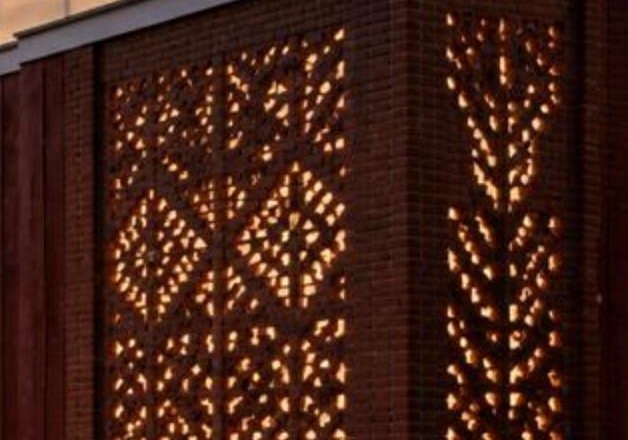
An illustrated comparison of a contemporary brick screen and historical traditions.
Original image supplied by the user. Nine-page research / design reference, 30 October 2026.
Historical references are linked; vector plates are clearly marked as contemporary studies.
Use ← and → to turn pages. Every chapter has its own link.
The provided picture is the point of departure; its building and designer remain unidentified.
The right elevation shows a central stem with repeated, diagonally diverging marks. It reads as a tree, wheat stalk, or stylized plant.
The wider elevation repeats rounded floral or grain-like clusters within a geometric matrix. Repetition, symmetry and backlighting intensify the glyph-like effect.
Hover the photo, or drag a finger across it, to look closely at single openings.
Backlighting turns the screen into a field of bright points. Pull those points out of the photograph and read them as a grid of pierced headers.
The photograph alone does not establish the building's location, construction date, architect, historical model, or cultural provenance. It may show a modern reinterpretation of pierced-brick ventilation. There is no verified one-to-one historical match for this particular arrangement.
PROVENANCE UNCONFIRMED
Pierced-brick gable ventilators: mid- to late-19th century, especially south-central Pennsylvania.
The Pennsylvania Historical & Museum Commission explicitly documents ornamental gable-end brickwork made to ventilate barns. Common forms include simple geometric openings and more elaborate wheat-sheaf motifs. The Kutztown historic marker also identifies the diamond and wheat-sheaf / hourglass as popular designs.
Start from a documented pattern, then pierce and fill headers by hand. Light it as the photograph is lit, watch the air move, and see how far your wall drifts from the documented forms.
They helped move air through hay and grain storage and allowed some natural light into the barn. Carefully positioned voids also showcased the mason's workmanship. Their arrangement needed to respect the wall's structural integrity.
Hex signs are painted circular stars or floral medallions. Wheat imagery suggests an agrarian theme, but the documented architectural purpose here is ventilation.
VIEW: Pennsylvania state historic-preservation guide ↗ VIEW: Kutztown Brick-End Decorated Barns marker ↗
Important distinction: The construction technique is authentic to the region. The exact flowering screen in the supplied photograph is not yet identified as a period Pennsylvania pattern.
Reference photographs are one click away; the diagrams below are schematic studies.
Tick "Compare" on two precedents to set them side by side.
These examples establish a family of pierced masonry techniques, not a chain of direct influence connecting the unknown building to any single historic farm.
Pennsylvania German decorated manuscripts often feature trees, flowers, branching stems and rosettes.
Fraktur is a separate tradition of ornamental writing and folk illustration, not a masonry method. Its flowering trees and symmetric botanical compositions offer a plausible visual parallel to the supplied screen, but no verified source for that specific design.
Two contemporary vector studies of historic Fraktur design vocabulary. They are newly drawn illustrations, not photographs or facsimiles of museum artworks.
Recompose the four plates: petals per bloom, bloom size, how thickly leaves grow, and palette. Every plate here is a new study, labelled as such when you download it.
SEE ORIGINAL HISTORICAL ART: Free Library / Fraktur tree ↗ SEE ORIGINAL HISTORICAL ART: Free Library / floral Fraktur ↗
The floral visual tradition is demonstrable; the claimed historical transfer to the photo is not.
These are new interpretive illustrations. To compare with original historical artworks, use the museum and archival references below. Samuel Gottschall's Flee from Sin (1883) and the Free Library's manuscripts provide closer documentary context than generic claims of "folk symbolism."
| Plate | Stems | Blooms | Symmetry | Extra element |
|---|
Counted from this app's plate drawings.
1883 / Samuel Gottschall [open collection] ↗ Free Library manuscript archive [open collection] ↗ Library of Congress holdings [open collection] ↗
Resemblance is a visual observation. Attribution requires much more evidence.
Lay a Fraktur plate over a brick wall and pierce every header a stem, petal or leaf crosses. Drag the divider to compare the drawing with its masonry.
Repeated diagonal marks, bilateral symmetry, stepped or gridded geometry, dense ornament, and stylized plant forms recur across many visual cultures. When flattened into a dark wall and backlit, the photograph can evoke glyphs or ancient carved reliefs. Such resemblance does not demonstrate Mesoamerican origin.
Sort each claim the way the sourcebook does, then check your audit against it.
Translation to the Pennsylvania 375 MW campus: legible history, contemporary execution.
The precedent is strongest when the campus takes the principle of pierced-brick gable ventilation and the geometry of documented diamond / hourglass / wheat-sheaf patterns, rather than presenting a new ornament as an exact antique.
Use measured diamond and hourglass brick fields on selected gable ends. Reference actual brick-end barn examples and physical bond patterns.
Reserve botanical Fraktur-derived flourishes for screens, entry pavilions, interior work, or interpretive signage. Label these modern motifs.
Put translucent glazing or a properly engineered rainscreen behind the patterned masonry; preserve waterproofing, fire separation, acoustics, maintenance, and secure building envelopes.
Compose a hall's gable end and its entry pavilion, then check the result against the three principles above.
Click any source title. These links contain the real reference photographs and artworks.
Field guide to barn details: documents ornamental gable-end brickwork made to ventilate barns, and the 1854 plank barn.
Historic marker naming the diamond and wheat-sheaf / hourglass as popular designs.
Photographed example with X / hourglass gable ventilators.
Branching / decorative perforation in a historic barn.
Diamond fields of ventilation holes, showing the broader technique.
An original Fraktur tree, linked beside plates A and B.
An original floral Fraktur, linked beside plates A and B.
Closer documentary context than generic claims of "folk symbolism".
The Free Library manuscript archive.
Library of Congress holdings.
The photographed building on the cover was supplied by the user; its origin is not verified. Other illustrated plates in this sourcebook are newly drawn interpretive vector diagrams, not original historical photographs or reproduced Fraktur artifacts. Original historic pictures and collection entries are available through the working links. Museum and photographer rights remain with their respective holders.
In this app, every brick field and plate is generated in your browser from simple rules. Pattern-matching scores and feature checks are this app's own heuristics: useful for seeing, not evidence of origin.